


A compact, timber-clad upper volume hovers above a fully glazed ground floor—balancing privacy, light control, and a strong indoor–outdoor connection.
The project is organized around a clear contrast between opacity and transparency. A screened timber “shell” wraps the upper level with vertical slats that filter daylight and soften views, while the ground floor is treated as a continuous glass perimeter that opens the living space to the surrounding landscape. The result is a calm, legible composition: protective where enclosure is needed, and expansive where the site becomes part of the interior experience.
Deep overhangs reinforce the sense of levitation and help regulate glare and heat gain at the glass line. Warm material tones—timber cladding, timber soffits, and restrained detailing—create a consistent atmosphere from outside to inside. At dusk, a discreet perimeter light line highlights the edge condition and turns the façade into a subtle lantern, emphasizing depth without full exposure.


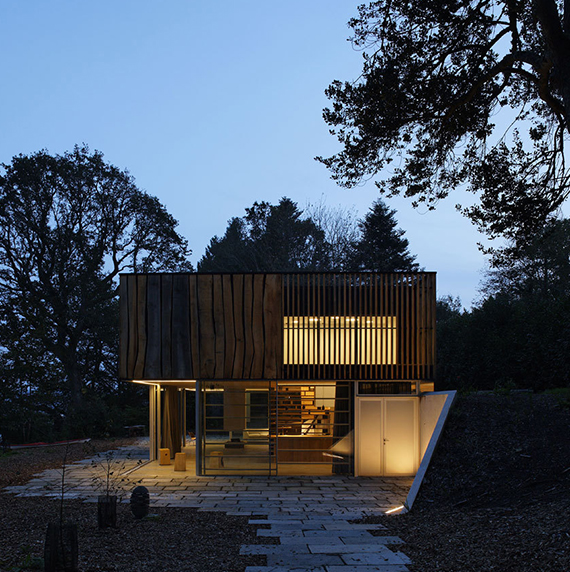
From the approach, exterior paving and the glazed façade align to produce a long threshold—neither strictly inside nor outside—where movement, reflections, and framed views shape the everyday sequence. The architecture stays intentionally quiet, letting proportion, shadow, and material texture carry the expression.
Defaulting to Calm
Instead of relying on complexity, the design leans on a few precise gestures: screening, cantilever, and transparency. The vertical slats modulate privacy without closing the building off, while the glass base maintains visual continuity with the terrain. This measured strategy makes the project feel simultaneously open and protected—an interior that expands outward, yet remains carefully controlled.
Defaulting to Mindfulness
Everything along the way, to and from, fascinated her: every pebble, ant, stick, leaf, blade of grass, and crack in the sidewalk was something to be picked up, looked at, tasted, smelled, and shaken. Everything was interesting to her. She knew nothing. I knew everything…been there, done that. She was in the moment, I was in the past. She was mindful. I was mindless.
Our greatest weakness lies in giving up. The most certain way to succeed is always to try just one more time.
In the end, the building’s character comes from calibration: how much is revealed, how much is filtered, and how light changes the reading of surfaces over time. The composition remains compact, but the experience is generous—defined by transparency at ground level, warmth above, and a deliberate, atmospheric presence after dark.